
The Rise of Rand Stablecoins
How digital dollars and rand-backed tokens are quietly transforming everyday checkouts.
So far in 2026, Bitcoin made up 39.9% of all checkout spending across the MoneyBadger payment network. Meanwhile, USDT took 36.1% and ZARU claimed 7.7%. Combined, these two stablecoins accounted for nearly 44% of total transaction value.
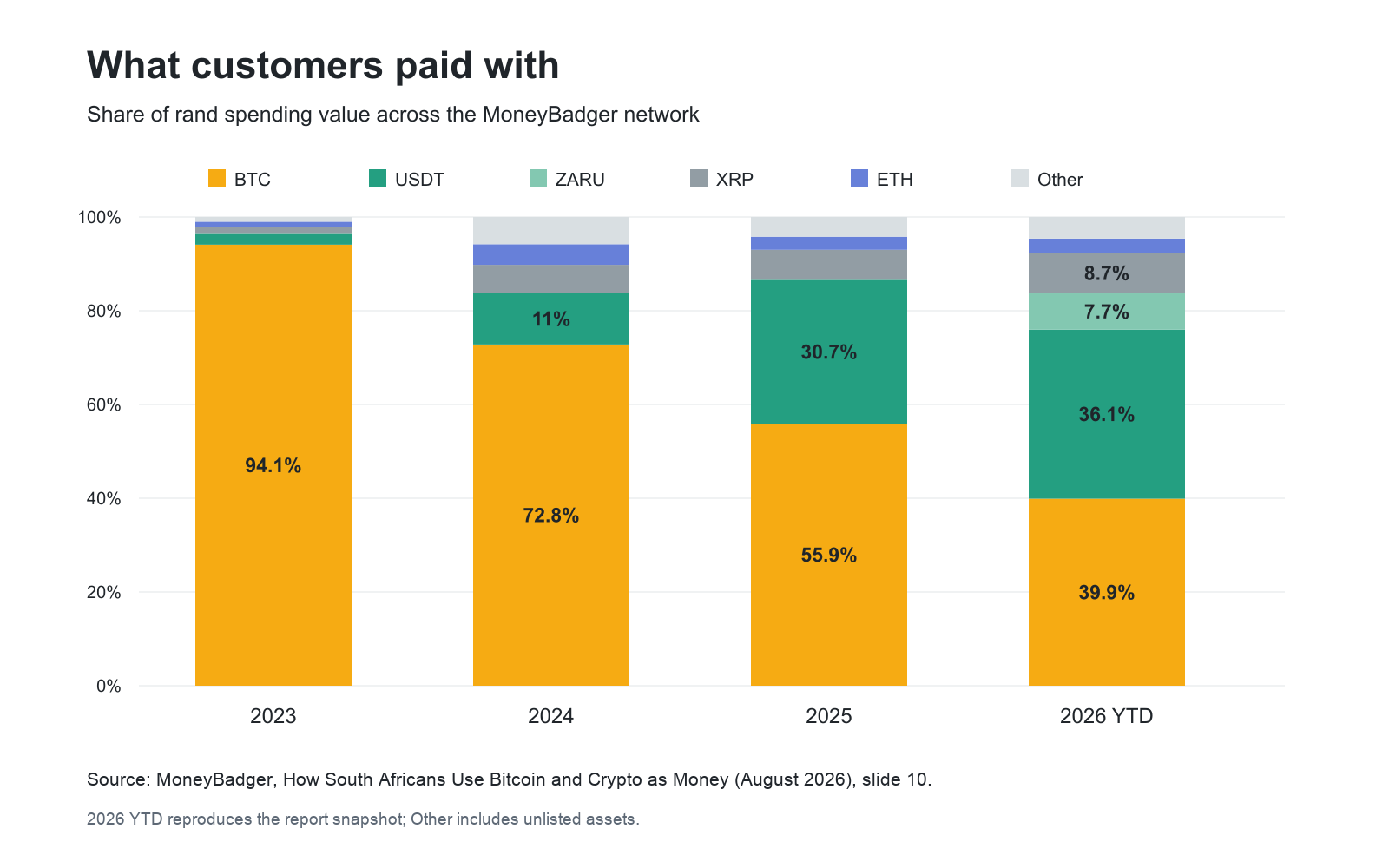
This shift isn't about one cryptocurrency replacing another. Instead, shoppers are picking specific tokens for specific jobs: using stable-value digital cash for daily purchases, and saving Bitcoin for broader wealth building. As a result, checkout habits are changing, while overall network usage keeps growing.
Measuring Spending, not just Trading
Most headlines about stablecoins focus on two numbers: total tokens created or total daily trading volume. While helpful, neither metric tells you whether people are actually using crypto to buy groceries, fill up on fuel, or pay for online shopping.
Our data comes directly from verified merchant transactions on the MoneyBadger network. While narrower than global market estimates, this real-world payment data reveals something far more practical: which digital assets people actually choose when paying for goods and services.
South African consumers are increasingly turning to rand-backed digital tokens for their daily purchases.
Two Rand Stablecoins hit the Market
Stablecoins are designed to keep a 1:1 price match with traditional money. Globally, US dollar stablecoins dominate, but South Africa now has several rand-backed tokens in issue, with two leading the local charge:
ZARsc (ZAR Supercoin): Launched in November 2025 by Super Money SA (Pty) Ltd, issuer of ZARsc under the Supercoin brand, an FSCA-licensed Crypto Asset Service Provider (FSP 53458) backed by NYSE-listed Super Group. ZARsc is issued onto Solana and backed in Rand, with reserves held at regulated South African financial institutions. ZARsc is listed on VALR, Luno and OVEX, three of South Africa’s largest crypto exchanges, and is also available on Orca, a Solana-based exchange.
ZARU (ZAR Universal): Introduced in February 2026 through a partnership between BlockTower South Africa, Luno, EasyEquities, Lesaka, and Sanlam Specialised Asset Management. Sanlam manages the underlying rand reserves, with Standard Bank and Absa their banking partners. Governance and mandates executed by specialist Tier 1 service providers are core tenants underpinning ZARU, positioning it as the institutional grade ZAR stablecoin.
Moore Johannesburg conducts independent agreed-upon monthly procedures on both these tokens’ reserves, with Supercoin and ZARU publishing the reports on their websites.
Both tokens aim for a stable 1:1 value with cash-backed reserves. Cashing out back into bank funds depends on the specific redemption channels set up by each issuer. Even though these issuers operate under financial regulator guidelines (FSCA), these tokens are digital assets rather than official government currency.
What the Checkout Numbers Tell Us
ZARU made an immediate impact. Monthly checkout value rose from R484,206.80 in June to R1,276,650.27 in September—2.64 times the June level. September was 10.6% higher than August, extending the growth shown after Luno Pay’s cashback campaign and workplace adoption initiatives.
A catalyst was Luno Pay’s cashback rewards program for ZARU purchases, combined with growing workplace adoption perks. The September data shows that momentum continued after the initial June-to-July surge. Luno has just launched a 15% crypto-back campaign at Engen, for customer with rand in their wallet to pay at checkout, and which is automatically converted to ZARU when processing.
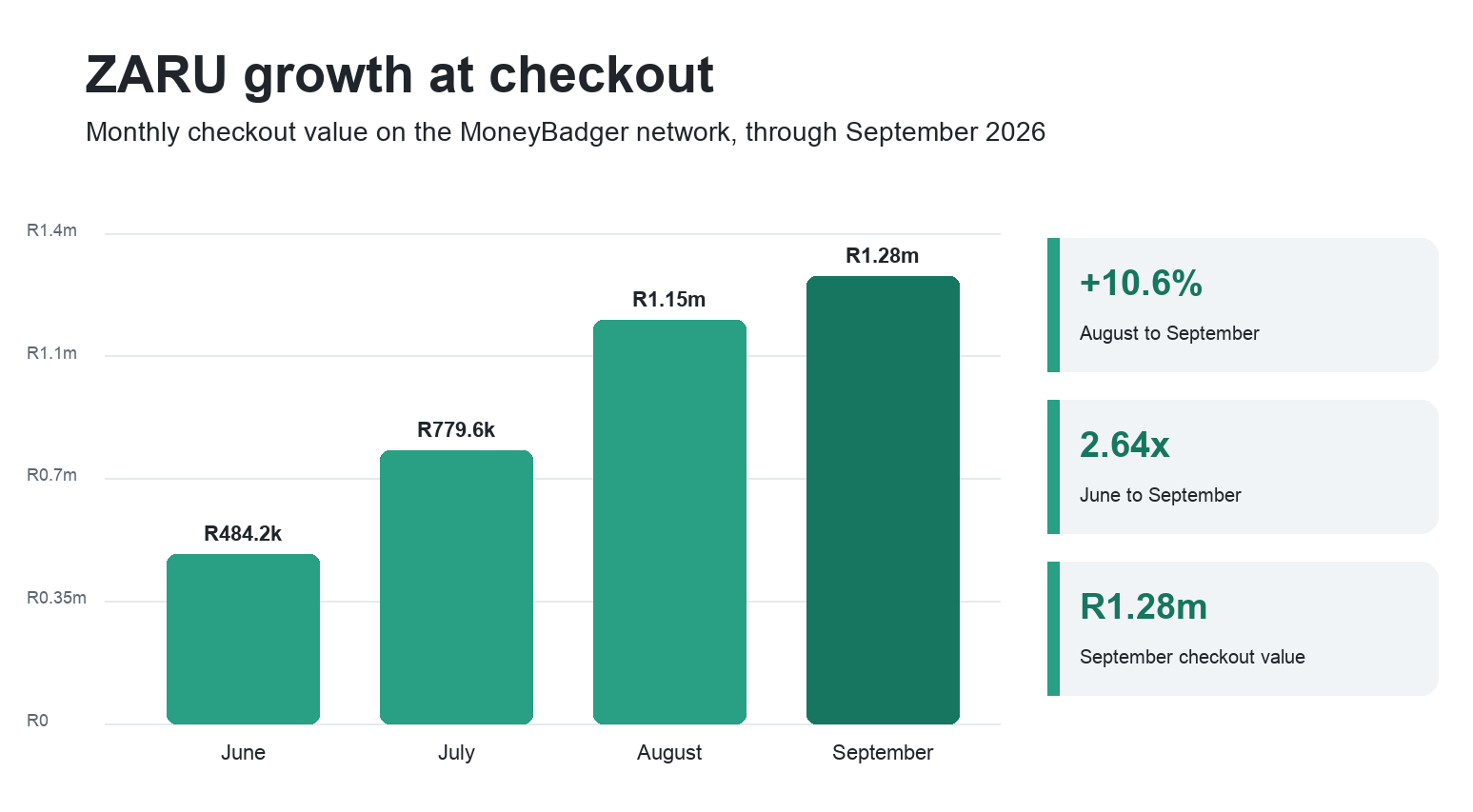
Figure 2. ZARU monthly checkout value continued to rise through September.
This quick adoption is especially impressive because customers have to intentionally purchase and store that particular token in their digital wallet prior to making a payment.
“The traction made by ZARU with MoneyBadger in such a short time showcases the utility and composibility of ZARU - it illustrates how institutions are able to build with it - be that rewards programs or employee perks. That is our core invitation to fintech, domestic payment, capital market, cross border settlement and retail institutions and teams - what will you build with ZARU?”
~ Aleks Andjelopolj, Chief Commercial Officer of BlockTower, the issuer of ZARU
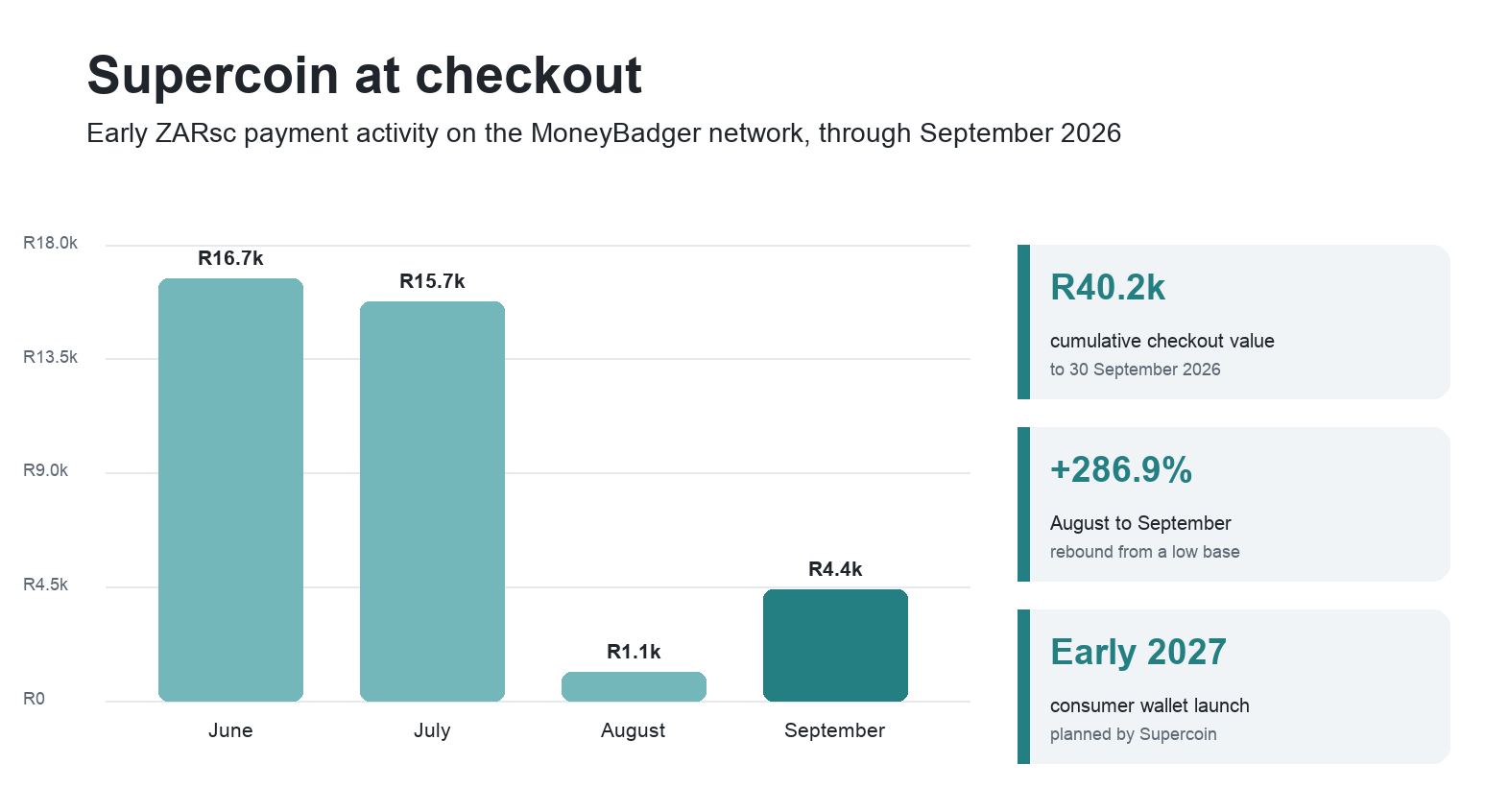
Figure 3. Supercoin’s ZARsc is shown separately to keep the focus on its own early checkout-adoption curve.
Supercoin’s ZARsc remains at an earlier stage of checkout adoption. It recorded R4,407.88 in MoneyBadger checkout value during September, up 286.9% from August’s low base, and R40,215.65 cumulatively through 30 September 2026. Supercoin has focused its first year on access: ZARsc is listed on VALR, Luno and OVEX and is also available on Orca. It is accepted across the MoneyBadger network, while the Supercoin consumer wallet is planned for early 2027. Read their whitepaper here.
This momentum reflects broad growth across our whole network. In the first half of 2026, total payment volume nearly doubled (+95%) and overall rand value jumped 176% compared to H1 2025. Merchant participation soared too, expanding from 57 active stores in August 2025 to 2,927 one year later.
“Dollar stablecoins have proven what this technology can do. But in South Africa, life runs in Rand. We get paid in Rand, pay tax in Rand, buy groceries in Rand, and pay businesses in Rand. ZARsc gives South African consumers and enterprises a Rand rail that's fast, open 24/7 and built so you don't have to wait for anyone. It will take time for stablecoins to reach the critical mass where they're accepted everywhere that money moves, which is why we're building the products to get there ourselves, starting with our wallet in early 2027.”
~ Gideon Greaves, Managing Director of Supercoin
Why Price Stability Works Best for Daily Shopping
Analyzing network trends clarifies why rand-backed tokens align so naturally with everyday shopping.
The checkout speed is fast: the August 2026 network benchmark showed a median scan-to-paid time of 35 seconds or less across checkout systems.
Shopping patterns mirror normal day-to-day retail habits with frequent, low-value buys throughout the month:
Everyday cart sizes: Half of all payments are under R200, and 87% are under R1,000.
Steady spending habits: People pay throughout the month, showing a slight uptick around the 11th–13th, rather than waiting for payday.
Repeat usage: Tracking five consecutive quarterly user groups shows 34% to 44% of primary wallet users return to spend again in following quarters.
When buying a quick R60 lunch, price swings introduce unwanted volatility and friction. A rand-backed token removes any valuation worries, providing a reliable digital unit for daily transactions.
For merchants, it's a win-win: customers pay with whichever token suits them, while the store receives standard rand settlement behind the scenes. Merchants can get the MoneyBadger integration by signing up with supported PSP partners, Ozow, Peach Payments, Zapper or Scan To Pay, and without needing to change anything on their end.
Sources: The payment-mix diagram and broader network figures reproduce MoneyBadger, How South Africans Use Bitcoin and Crypto as Money (August 2026), including its original reporting period. September token-specific checkout values come from the MoneyBadger data through 30 September 2026. Values reflect confirmed MoneyBadger checkout activity only and not issuer-wide circulation or trading volumes.
BlockTower is a regulated issuer of emerging-market stablecoins and is a distributor of Luno’s embedded wallet-as-a-service. Its first product, ZAR Universal (ZARU), is an institutional-grade Rand stablecoin issued by BlockTower under an FSCA licence. ZARU is pegged one-to-one to the Rand and fully backed by Rand reserves held onshore in South Africa in Standard Bank and Absa bank accounts. Reserves are independently attested by Moore Johannesburg on a monthly basis, and are made available on its website. Luno Global, EasyEquities and Lesaka are founding distribution partners of ZARU.
Qualified institutional clients can mint and redeem ZARU directly through BlockTower’s self-service issuance platform. ZARU USDT and USDC pairs trade on Luno Global in South Africa, Nigeria, Kenya, Uganda, Bermuda and has approval to launch in Indonesia. ZARU is live on Circle’s Arc network, where it is the chosen Rand stablecoin for the Circle StableFX program. BlockTower is adding additional South African and Global exchanges and OTC desks as secondary liquidity venues, and plans stablecoin launches across key African and Asia-Pacific markets.
BlockTower South Africa (Pty) Ltd is an authorised financial services provider (FSP No. 55172). blocktower.tech
Supercoin puts the Rand on rails. Its first product, ZARsc, is a Rand-pegged stablecoin issued onto Solana and listed on VALR, OVEX, Luno and Orca. Exchanges, platforms and businesses use it to move and settle Rands at any hour of any day. ZARsc is backed in Rand. Moore provides independent monthly procedures with published reports, Fireblocks secures custody and Chainalysis monitors activity on chain. The Supercoin wallet launches in early 2027, giving people one place to send, spend, top up and cash out. Supercoin is backed by NYSE-listed Super Group (SGHC) and starts in South Africa, with a family of stablecoins for Africa in view.
Supercoin is the trading name of Super Money SA (Pty) Ltd, an FSCA-licensed Crypto Asset Service Provider under FAIS Act 37 of 2002, FSP 53458. supercoin.co.za
